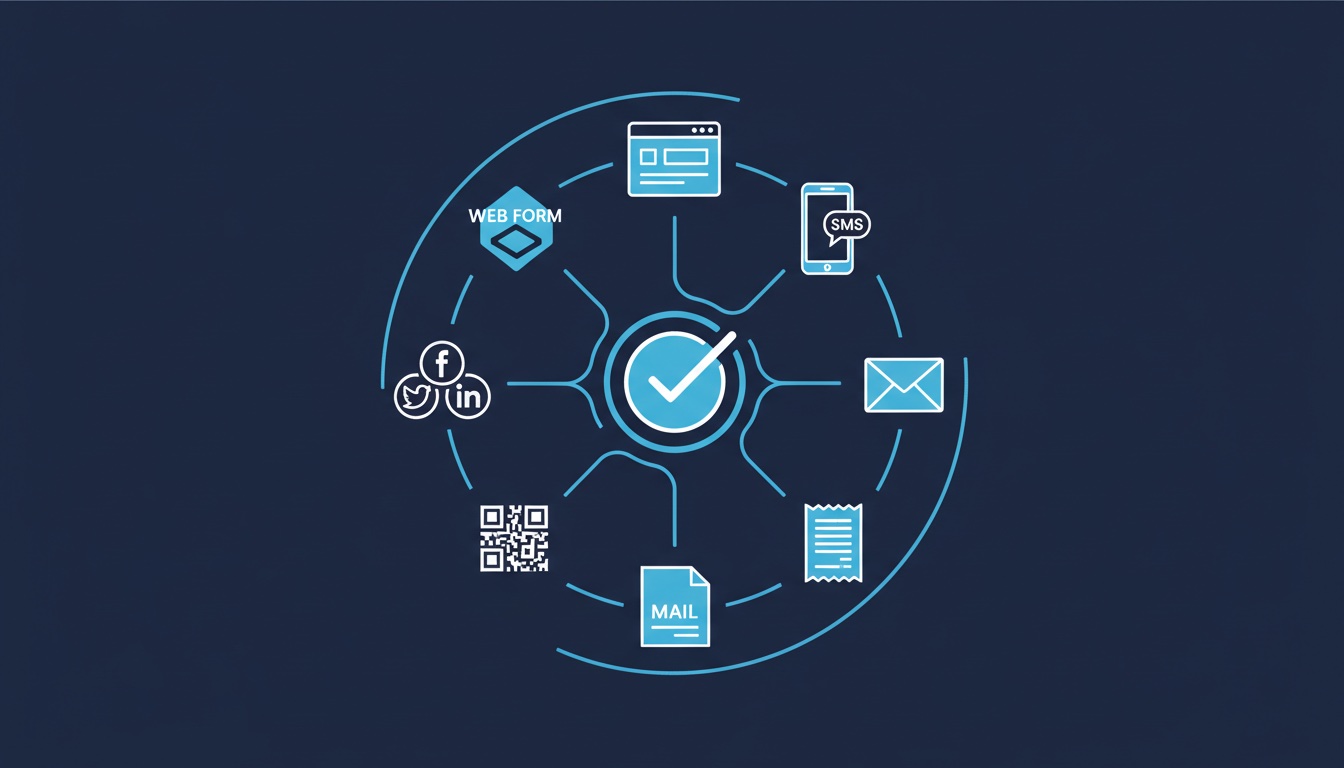
The entry method is where strategy meets experience. It determines who enters, how many enter, what data you collect, and what compliance obligations you trigger. Choosing the right entry method — or the right combination of methods — is one of the most consequential decisions in sweepstakes design.
This guide covers every major entry method: how it works, when to use it, what it costs, and what compliance requirements come with it.
Entry Methods at a Glance
| Method | Friction | Data Capture | Cost to Run | AMOE Valid? |
|---|---|---|---|---|
| Online form | Low | High (name, email, custom fields) | Low | Yes |
| Social media action | Very low | Low (handle only) | Low | Varies — see below |
| SMS / text-to-enter | Very low | Medium (phone number) | Moderate | Yes |
| Mail-in entry | High | Low (name, address) | Low | Yes — most traditional |
| Purchase + receipt upload | Moderate | High (purchase data + contact) | Moderate-High | No — needs separate AMOE |
| Product code entry | Low-Moderate | Medium (code + contact info) | Higher (printing) | No — needs separate AMOE |
| QR code scan | Very low | Medium (varies by destination) | Low-Moderate | Varies |
| In-person / event entry | Moderate | Medium (form at event) | Low | Yes (if free event) |
| App-based entry | Moderate | Very high (app data + entry) | High (app required) | Varies |
Online Form Entry
The most common entry method for digital sweepstakes. Participants visit a landing page and complete a form to enter.
How It Works
Participant visits the entry page, fills in required fields (typically name, email, and any custom fields), agrees to official rules, and submits. The system records the entry, sends a confirmation, and adds the entrant to the drawing pool.
Advantages
- Rich data capture: Collect email addresses, demographic information, survey responses, and marketing opt-ins in a single interaction
- Scalable: Handles thousands to millions of entries without manual processing
- Trackable: Full analytics on entry sources, conversion rates, and drop-off points
- Low cost: Platform subscription is the primary cost. No per-entry fees for most tools.
- AMOE-eligible: A web form with no purchase requirement is a valid free entry method
Disadvantages
- Requires a landing page (design and hosting costs)
- Form length inversely correlates with entry rate — more fields = fewer entries
- Susceptible to bot entries without proper validation (CAPTCHA, email verification)
Optimize form length for your goal
For maximum entries: name + email only. Every additional field reduces completion by 5-10%. For qualified leads: add 2-3 targeted fields (company size, role, interest). You'll get fewer entries but higher-quality contacts. Match form length to your campaign goal, not your curiosity.
Social Media Entry
Participants enter by performing a social media action: following an account, liking a post, commenting, sharing, or using a hashtag.
How It Works
Brand posts a sweepstakes announcement with entry instructions. Participants complete the specified action(s). At promotion end, the brand collects eligible entries and selects a winner — typically using a comment picker tool or by exporting follower/engagement data.
Advantages
- Lowest friction: Actions most users already perform (like, follow) = maximum participation
- Built-in viral distribution: Comments, shares, and tags expose the promotion to participants' networks
- Audience building: Direct follower growth as an entry mechanic
Disadvantages
- Limited data capture: You get a username, not an email address or contact details
- AMOE complexity: Whether social actions constitute "consideration" is debated. Always offer an alternative free entry to be safe
- Platform dependency: Each platform has its own promotion rules. See our social media legal requirements guide
- Documentation challenges: Proving who liked/followed/commented requires screenshots or API data
Social entry alone is not enough for data capture
If your campaign goal is email acquisition, social media entry doesn't achieve it — you get handles, not emails. Use a hybrid approach: require a social action for visibility, then link to an online form for the actual entry. This captures emails while still leveraging social distribution.
For detailed platform-by-platform guidance, see our social media contest guide.
SMS / Text-to-Enter
Participants text a keyword to a short code or toll-free number to enter.
How It Works
Promotional materials display: "Text WIN to 12345 to enter." Participant sends the text. The system responds with a confirmation and may request additional information (name, email) via reply texts or a link to a web form.
Advantages
- Very low friction: Everyone has a phone. No app download, no form to fill out.
- Mobile-first: Ideal for audiences who primarily engage via mobile (events, retail, radio promotions)
- Phone number capture: Valuable for SMS marketing, remarketing, and two-factor verification
- AMOE-eligible: Standard messaging rates are generally not treated as consideration
Disadvantages
- Requires a short code or toll-free number ($500-$1,000/month for dedicated short codes)
- Limited data capture in the initial interaction (phone number only)
- TCPA compliance required for follow-up messages (explicit opt-in for marketing texts)
- Some carriers treat short code messages differently, which can affect deliverability
Mail-In Entry
The original sweepstakes entry method — and still the most universally accepted AMOE.
How It Works
Participant handwrites their name, address, phone number, and email on a 3x5 index card and mails it to a specified P.O. box. One entry per stamped, hand-addressed outer envelope.
Advantages
- Universally accepted as a valid AMOE: No court or regulator has ever questioned the legitimacy of a mail-in entry as a free entry method
- Low implementation cost: Just a P.O. box and manual processing
- Deters casual entries: The effort required means most entries come through the primary (digital) method, which is often what you want
Disadvantages
- Manual processing required (opening, recording, entering into system)
- Slow turnaround (mail transit + processing time)
- Not real-time — entries may arrive after the drawing if mailed near the deadline
- Limited data capture and no digital tracking
Purchase-Triggered Entry
Participants earn entries by making a qualifying purchase and submitting proof — typically a receipt photo, product code, or loyalty card scan.
How It Works
Customer buys a qualifying product, then submits proof of purchase (receipt upload, code entry, barcode scan). The system validates the purchase and records the entry. A separate free AMOE must be available for non-purchasers.
Advantages
- Direct sales attribution: Every entry represents a verified purchase
- Rich purchase data: Retailer, product, price, date, location — all from receipt uploads
- Repeat engagement: Multiple purchases = multiple entries (if rules allow)
Disadvantages
- Must have AMOE: Purchase entry alone = illegal lottery. A free entry path is legally required
- Higher friction: Receipt upload is more effort than a simple form fill
- Validation complexity: OCR, fraud detection, and manual review required
- Higher cost: Receipt processing technology and administration
For complete guidance on purchase-triggered promotions, see our purchase sweepstakes guide.
 Revup
Revup
Revup supports every entry method — online forms, SMS, receipt upload, product codes, social actions, and mail-in processing — all from one platform.
Product Code Entry
Unique codes printed on product packaging, inside caps, under labels, or on in-pack inserts.
How It Works
Customer purchases a product, finds the unique code, and enters it on the promotion website or via SMS. The system validates the code (one-time use), records the entry, and may reveal an instant win result.
Best For
- Beverages (under-the-cap codes)
- Packaged food (in-pack or on-pack codes)
- Any physical product where packaging can carry a code
Advantages and Disadvantages
| Advantage | Disadvantage | |
|---|---|---|
| Fraud prevention | Unique codes prevent duplicate entries | Code generation and printing add cost |
| Verification | Each code validates a real purchase | Lost/damaged codes create customer service issues |
| Engagement | Code entry creates an interactive moment | Requires customer to find and enter the code |
| Instant win compatible | Codes can trigger instant win results | Algorithm complexity increases |
QR Code Entry
Participants scan a QR code on packaging, displays, or print materials. The code directs them to the entry page — prefilled with campaign data and optionally with a unique identifier.
Best For
- In-store and point-of-purchase displays
- Event activations and booth traffic
- Product packaging (bridging physical product to digital entry)
- Print advertising and direct mail
Choosing the Right Entry Method
| Campaign Goal | Primary Entry | AMOE | Why This Combination |
|---|---|---|---|
| Email acquisition | Online form | Mail-in | Form captures email; mail-in deters AMOE-only entries |
| Social growth | Social action + form link | Online form (no social required) | Social action drives follows; form captures data |
| Purchase lift | Receipt upload | Online form or mail-in | Receipts prove purchase; AMOE provides free path |
| Mobile engagement | SMS text-to-enter | Online form | SMS is frictionless on mobile; form is the web AMOE |
| In-store traffic | QR code → form | Mail-in or online form | QR bridges physical to digital; AMOE for non-shoppers |
| Instant win engagement | Online game (spin/scratch) | Mail-in with pre-drawn results | Game drives engagement; mail-in AMOE for offline players |
Use multiple entry methods to maximize reach
The most successful sweepstakes offer 2-3 entry methods: a primary method aligned with the campaign goal (e.g., purchase + receipt upload), a digital AMOE (online form), and a traditional AMOE (mail-in). This maximizes both participation and compliance.
AMOE Requirements by Entry Method
Every sweepstakes needs at least one free AMOE. Here's how different primary entry methods interact with the AMOE requirement:
| Primary Entry | Is It Free? | AMOE Required? | Recommended AMOE |
|---|---|---|---|
| Online form (no purchase) | Yes | Already qualifies as AMOE | N/A — the form IS the free entry |
| Social media (follow/like) | Debated | Yes — to be safe | Online form (no social required) |
| Purchase + receipt upload | No (requires purchase) | Yes — mandatory | Online form + mail-in |
| Product code | No (requires purchase) | Yes — mandatory | Online form + mail-in |
| SMS text-to-enter | Mostly yes | Recommended | Online form |
| In-person / event | Depends on event | If event is paid: Yes | Online form + mail-in |
For comprehensive AMOE guidance, see our Alternative Method of Entry guide.
Frequently Asked Questions
Can I combine multiple entry methods in one sweepstakes?
Yes — and you should. Most successful sweepstakes offer a primary entry method (aligned with the campaign goal) plus one or two AMOEs. All entry methods feed into the same drawing pool. Entries from all methods must have equal odds of winning.
Which entry method gets the most entries?
Social media actions (follow/like) generate the highest raw entry volume because of minimal friction. Online forms generate the most useful entries because they capture contact data. Purchase entries generate the highest-value entries because they represent actual customers. Choose based on your goal, not just volume.
Does requiring email verification reduce entries?
Yes — typically by 15-25%. But it dramatically improves entry quality by eliminating fake emails, bots, and duplicate entries. For email acquisition campaigns, always require verification. For maximum-volume campaigns, it's a trade-off.
How do I prevent fraud across entry methods?
Layer multiple controls: email verification, IP monitoring, CAPTCHA, device fingerprinting, and manual review of suspicious patterns. For purchase entries, add receipt OCR validation and duplicate detection. No single control is sufficient — use defense in depth.
For the complete sweepstakes setup guide, see how to run a sweepstakes legally or read the full How to Run a Sweepstakes guide.