Running a sweepstakes is one of the most effective promotional tools available to brands — for email acquisition, social engagement, product launches, and customer loyalty. But the legal framework governing sweepstakes in the United States is specific, enforced, and unforgiving when you get it wrong.
This guide walks through every step of running a legally compliant sweepstakes, from initial planning through winner fulfillment. Follow it in order, and you'll avoid the compliance gaps that expose brands to FTC enforcement, state penalties, and participant lawsuits.
The cardinal rule of sweepstakes law
A sweepstakes must have prize and chance but never consideration (payment). If participants must pay to enter — without an equally accessible free alternative — your promotion is an illegal lottery. This single requirement governs every decision in this guide.
Step 1: Confirm Your Promotion Is a Sweepstakes
Before anything else, classify your promotion. U.S. law recognizes three types of prize promotions, each with different legal requirements:
| Sweepstakes | Contest | Lottery | |
|---|---|---|---|
| Winner selection | Random (drawing, RNG, instant win) | Skill-based judging | Random |
| Payment to enter | No (free entry required) | Allowed | Required (ticket purchase) |
| Legal for brands? | Yes | Yes | No — illegal privately |
| Key requirement | Must offer free AMOE | Genuine judging criteria | N/A |
If your promotion selects winners randomly and you plan to offer a prize, you're running a sweepstakes. The rest of this guide applies to you. If you're selecting winners based on skill or merit, you're running a contest — different rules apply.
For a deeper explanation of the three-element test, see our guide to sweepstakes vs contest vs lottery.
Step 2: Define Your Campaign Goals and Structure
Before drafting rules or building entry forms, define what you're trying to achieve. Your campaign goals determine the promotion structure, which in turn determines your compliance obligations.
Common sweepstakes goals and their structural implications:
- Email acquisition: Simple entry form, single entry per person, moderate prize value. Straightforward compliance.
- Social media engagement: Entry via follow/like/comment, with a separate free entry option. Requires platform-specific compliance.
- Purchase-linked promotion: Entries earned through product purchase, with a mandatory free AMOE. More complex compliance — see our purchase sweepstakes guide.
- Instant win game: Real-time prize reveals with predetermined odds. Requires additional odds documentation — see our instant win guide.
- Brand awareness / reach: High-value prize, broad eligibility, maximum promotion. Standard compliance with state registration likely required.
Step 3: Choose Your Prize Strategy
Your prize determines entry volume, regulatory obligations, and campaign economics. Key considerations:
- Prize value determines state registration. Prizes over $5,000 trigger registration requirements in New York and Florida. Prizes over $500 trigger Rhode Island registration for retail/in-store promotions only (online-only sweepstakes are exempt). Factor this into your budget and timeline.
- Cash prizes are simplest. No fulfillment logistics, no valuation disputes. The IRS reporting threshold is $2,000 for cash prizes.
- Product prizes need an Approximate Retail Value (ARV). Your official rules must state the ARV of every non-cash prize. Use the manufacturer's suggested retail price or documented market value.
- Experience prizes carry liability. Travel, events, and experiences require additional terms covering cancellation, substitution, travel insurance, and companion eligibility.
For detailed prize selection guidance by campaign type and budget, see sweepstakes prize ideas.
Step 4: Draft Your Official Rules
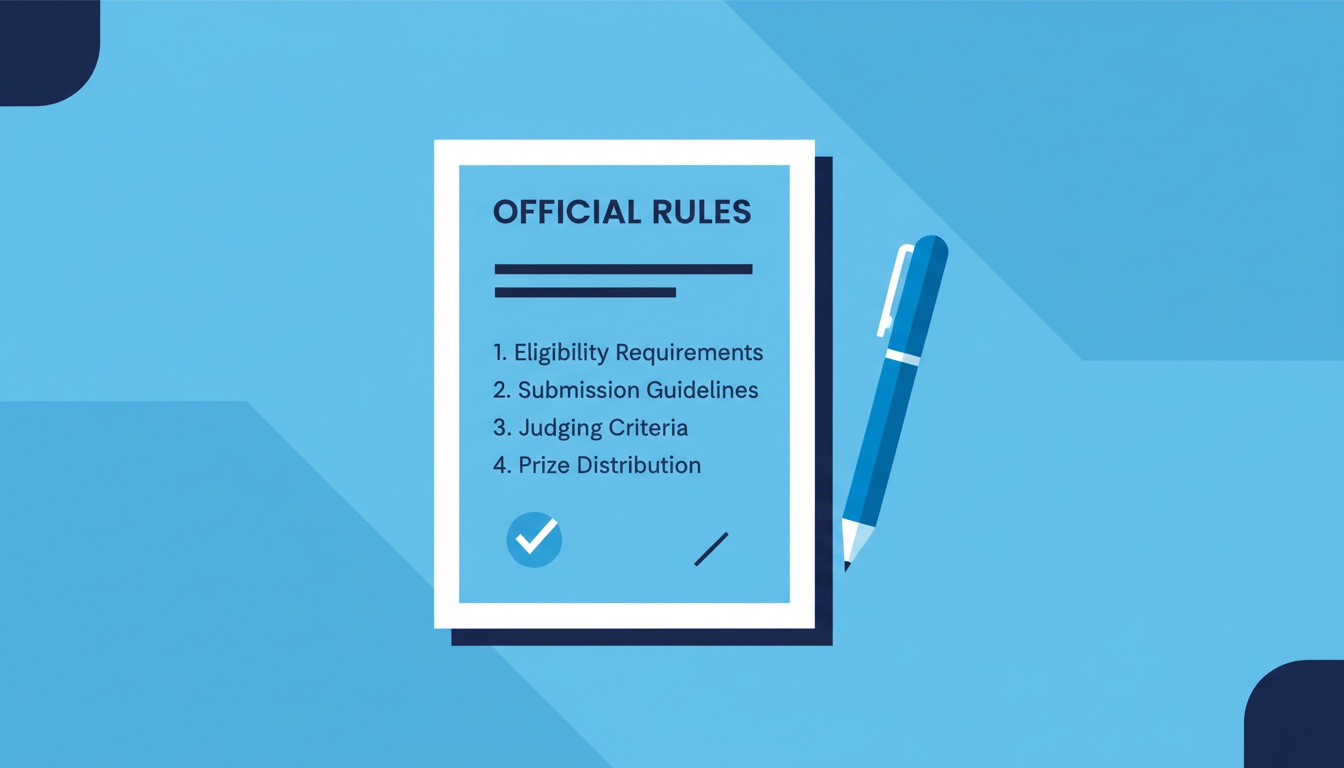
The official rules document is the legal backbone of your sweepstakes. It functions as the binding agreement between sponsor and participants. Every sweepstakes — regardless of size — must have official rules.
Official Rules Must Include
- Sponsor name and full mailing address
- "No purchase necessary to enter or win" statement
- Eligibility requirements (age, residency, employee exclusions)
- Promotion period with exact start and end dates/times with timezone
- All entry methods, including the free AMOE
- Entry limits per person
- Prize descriptions with Approximate Retail Value (ARV)
- Odds of winning or statement that odds depend on entries
- Winner selection method and date
- Winner notification method and response deadline
- Prize fulfillment terms and timeline
- General conditions, release, and limitation of liability
- Governing law (which state's laws apply)
- Winner list availability statement
- Void where prohibited disclosure
Poorly drafted official rules are the single most common source of sweepstakes legal disputes. Ambiguous notification timelines, missing substitution clauses, and vague eligibility definitions have all triggered lawsuits. For a clause-by-clause walkthrough, see our guide to writing sweepstakes official rules.
 Revup
Revup
Revup generates compliant official rules automatically based on your promotion parameters — eligibility, entry methods, prize details, and required disclosures included.
Step 5: Set Up Your Free Entry Method (AMOE)
Every sweepstakes must provide a free Alternative Method of Entry (AMOE) that gives participants the same odds of winning as any paid or purchase-linked entry. This is what separates your sweepstakes from an illegal lottery.
Valid AMOE options include:
- Online form entry: A web form that requires no purchase, subscription, or account creation
- Mail-in entry: A handwritten entry on a 3x5 card mailed to a designated P.O. box
- Text/SMS entry: A toll-free text-to-enter option
The AMOE must provide equal odds
If purchasers receive 5 entries and free entrants receive 1, you haven't eliminated consideration — you've discounted it. Courts treat unequal odds as preserved consideration, which can reclassify your sweepstakes as an illegal lottery. Keep entry chances equal across all methods.
The AMOE must be disclosed prominently — in your official rules, on every entry page, and in all promotional materials. Hiding the free entry option in fine print is treated by regulators as not having one at all. For complete AMOE guidance, see our AMOE guide.
Step 6: Check State Registration Requirements
If your sweepstakes is open to residents of all 50 states and your total prize value exceeds certain thresholds, you must register in advance with specific state agencies.
State Registration Requirements
New York — File 30 days before launch
Register with the NY Department of State. Surety bond equal to total prize value required. Post-promotion: file winners list and financial statement within 90 days.
Florida — File 7 days before launch
Register with the FL Department of Agriculture and Consumer Services. Surety bond or trust account required for prizes over $5,000. Annual reporting required.
Rhode Island — File before launch (retail only)
Register with the Secretary of State for prizes worth $500 or more if your promotion has a physical retail component in RI. Online-only sweepstakes are exempt. No bonding requirement, but specific disclosure rules apply.
New York's 30-day advance filing requirement is the binding constraint for most national sweepstakes. Build this into your campaign timeline from day one. If registration isn't feasible, you can exclude these states using the "void where prohibited" clause — but that reduces your reach. For full filing details, see our state registration guide or explore the interactive state law map for requirements in all 50 states.
Step 7: Build Your Entry Experience
With rules drafted and registration filed, build the actual entry experience. Key requirements:
- Official rules must be linked from every entry point. A direct link to the full rules — not a summary, not a popup excerpt — must be visible on every page where someone can enter.
- "No Purchase Necessary" must be displayed prominently. This statement must appear on the entry page, in all advertising, and in the official rules.
- Age-gating must be implemented at the entry point if your promotion has age restrictions (not just stated in the rules).
- AMOE must be equally accessible. If your primary entry is a web form, your free entry option can't require a phone call to a hard-to-find number.
- Data collection must comply with privacy laws. Only collect information necessary for the promotion. Disclose how you'll use participant data. If your promotion involves minors or California residents, COPPA and CCPA apply.
Step 8: Launch and Monitor
Once live, actively monitor your sweepstakes for compliance issues and irregularities:
- Verify entry integrity. Watch for duplicate entries, bot submissions, and entries from excluded jurisdictions.
- Document everything. Maintain records of entry volumes, AMOE usage, any issues that arise, and how they were resolved.
- Respond to inquiries promptly. Participant questions about rules, eligibility, or entry methods must be answered accurately and consistently.
- Don't change rules mid-promotion. If you must amend your official rules after launch, document the change clearly, notify existing entrants if material, and never reduce prize values or change winner selection methods retroactively.
Step 9: Select and Notify Winners
Winner selection must follow exactly the method described in your official rules.
Winner Selection & Fulfillment Process
Conduct the drawing
Use the random selection method specified in your rules (RNG, random.org, certified drawing). Document the selection process — date, time, method, witness if applicable.
Verify winner eligibility
Confirm the winner meets all eligibility requirements in your rules: age, residency, entry method, employment exclusions.
Notify the winner
Use the notification method stated in your rules (email, phone, mail). Give the response deadline stated in your rules — typically 5-14 days.
Collect required documentation
Affidavit of eligibility, liability release, publicity release (where legal), and IRS Form W-9 for prizes valued at $2,000 or more.
Fulfill the prize
Deliver the prize within the timeline stated in your rules. For prizes over $2,000, file IRS Form 1099-MISC by January 31 of the following year.
If a winner doesn't respond within the deadline, or fails verification, select an alternate winner using the same documented process. For detailed guidance on random selection methods and documentation, see how to pick a random winner.
Step 10: Complete Post-Promotion Obligations
Your compliance obligations don't end when the winner is announced. Post-promotion requirements include:
Post-Promotion Compliance Checklist
- Winner list published or available upon request (as stated in rules)
- State post-promotion filings completed (NY: winners list + financial statement within 90 days)
- IRS Form 1099-MISC filed for prizes over $2,000 (by January 31)
- W-9 forms collected and securely stored
- Promotion records archived for minimum 7 years
- Surety bond release requested (after state filings accepted)
The Complete Launch Timeline
Working backward from your desired launch date, here's the timeline you need to plan for:
| Timeframe | Action | Details |
|---|---|---|
| 8-6 weeks before | Define goals + prize strategy | Campaign structure, prize selection, budget allocation |
| 6-5 weeks before | Draft official rules | All required clauses, legal review recommended for prizes over $5K |
| 5-4 weeks before | File state registrations | NY requires 30 days. FL requires 7 days. File NY first. |
| 4-3 weeks before | Build entry experience | Entry forms, AMOE, age-gating, rules link, NPN display |
| 2-1 weeks before | QA and compliance review | Test all entry paths, verify disclosures, confirm state approvals |
| Launch day | Go live + monitor | Verify entry flow, monitor for issues, document everything |
| Promotion end | Select winners + fulfill | Random drawing, eligibility verification, prize delivery |
| Within 90 days after | Post-promotion filings | State reports, IRS 1099s, record archival |
Revup
Revup handles the entire sweepstakes workflow — from entry forms and official rules to random winner selection and state registration tracking.
Frequently Asked Questions
Do I need a lawyer to run a sweepstakes?
For sweepstakes with total prize values under $5,000, using compliant templates and a platform like Revup that generates rules automatically may be sufficient. For prizes over $5,000 — especially national campaigns that require state registration — legal review of your official rules is strongly recommended.
Can I run a sweepstakes on social media without official rules?
No. Every sweepstakes must have official rules, regardless of the platform. A social media post that says "like and share to win" without linking to official rules violates FTC requirements and the promotion guidelines of every major platform.
What happens if I forget the AMOE?
Without a free alternative method of entry, your sweepstakes becomes an illegal lottery (prize + chance + consideration). Consequences include FTC enforcement, state attorney general action, participant lawsuits, and potential criminal charges under postal lottery statutes.
How much does it cost to run a compliant sweepstakes?
Beyond the prize itself, budget for: official rules drafting or platform subscription, state registration fees ($100-$500 per state), surety bond premiums (1-3% of prize value), and administration time. For a $5,000 prize national sweepstakes, total compliance costs typically run $500-$2,000.
Can I change the rules after launching?
Only under limited circumstances, and never in ways that disadvantage existing entrants. Extending the promotion period or adding prizes is generally acceptable. Reducing prize values, changing eligibility, or altering the winner selection method is not. Any amendment must be documented and communicated to existing participants.
Ready to go deeper? Read the full How to Run a Sweepstakes: Complete Guide for Brands, or start with specific topics like writing your official rules or promoting your sweepstakes.