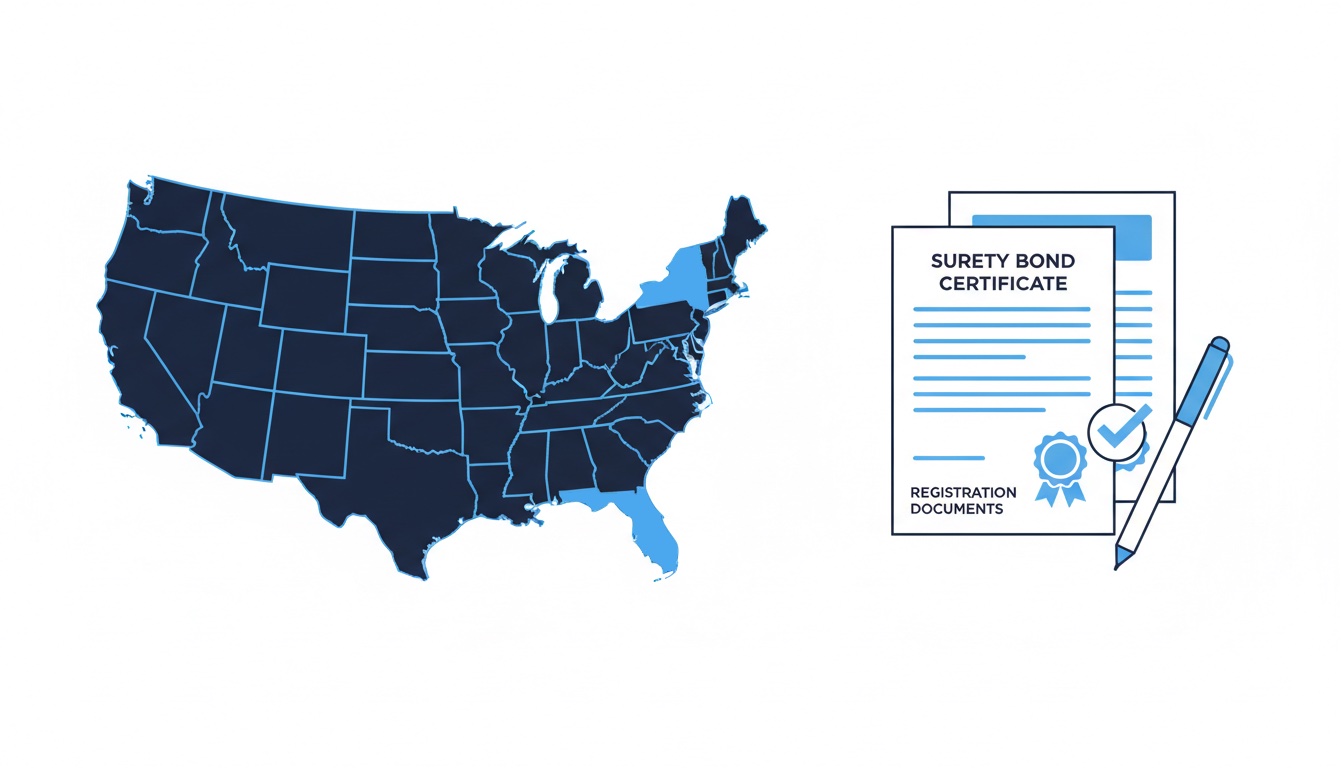
Most brands running a sweepstakes only think about federal rules — the FTC, the postal lottery statute, no-purchase-necessary requirements. But certain U.S. states impose an additional layer of compliance that operates entirely separately from federal law. New York and Florida require sponsors to register their sweepstakes and post a bond before the promotion opens to the public. Rhode Island also has a registration requirement — but only for promotions conducted in physical retail establishments, not for online-only sweepstakes.
Miss the NY or FL filings and you're not just technically non-compliant — you're running an illegal promotion in states that actively enforce these requirements. This guide covers what each state requires, the prize value thresholds that trigger registration, how to file, and how to structure your promotion to stay compliant.
Registration must happen before launch
You cannot file retroactively. New York and Florida both require registration to be completed — and in most cases approved — before you accept the first entry. Running a qualifying promotion without filing exposes you to fines, cease-and-desist orders, and potential disgorgement of prizes.
Which States Require Registration?
New York and Florida impose advance registration and bonding requirements on sweepstakes with prize pools over $5,000. Rhode Island requires registration only for promotions conducted in physical retail establishments — online-only sweepstakes are not subject to Rhode Island's registration requirement. Every other state either has no registration requirement or has repealed its sweepstakes registration laws (Arizona and Connecticut previously required registration but no longer do).
New York
Registration requiredFlorida
Registration requiredRhode Island
Registration requiredFor New York and Florida: if your total prize pool meets or exceeds $5,000, registration is required — regardless of whether the promotion is online or in-store. The requirement is triggered by the prize value and openness to state residents, not the promotion channel.
For Rhode Island: the requirement applies only if your sweepstakes is conducted in a physical retail establishment in Rhode Island (e.g., in-store ballot boxes, point-of-sale entry, receipts from Rhode Island store locations). A purely digital sweepstakes with no in-store component does not trigger Rhode Island's registration requirement.
New York Requirements
New York's sweepstakes law is administered by the New York Department of State. Any sweepstakes with a total prize value of $5,000 or more that is open to New York residents requires advance registration.
What New York Requires
- Registration form: Official Rules must be filed with the Department of State before the promotion opens. The rules must include all required disclosures (see our official rules template).
- Surety bond: A bond equal to the total value of all prizes must be posted with the state. The bond protects consumers — if the sponsor fails to award prizes, the bond ensures winners can be paid.
- Filing fee: New York charges a filing fee based on total prize value. Fees typically range from $50–$500 depending on the prize pool.
- Registration number: Once approved, New York issues a registration number that must be included in your official rules and promotional materials distributed in New York.
New York Bonding
The bond amount equals the total ARV (Approximate Retail Value) of all prizes. For a sweepstakes with $10,000 in prizes, you need a $10,000 surety bond. Bonds are typically purchased from a surety company or insurance provider at a small percentage of the face value (usually 1–3% annually). A $10,000 bond typically costs $100–$300 per year.
Bond vs. cash deposit
New York accepts either a surety bond (purchased from a licensed surety company) or a cash deposit held in escrow. Most sponsors use surety bonds since they only require paying the premium (1-3% of bond amount) rather than tying up the full prize value in cash. Your attorney or a specialized sweepstakes insurance provider can arrange the bond.
Florida Requirements
Florida's requirements are governed by the Florida Department of Agriculture and Consumer Services. The threshold is also $5,000 in total prize value. Florida's registration system is one of the most actively enforced in the country.
What Florida Requires
- Registration filing: Official rules must be filed before the promotion opens. Florida provides a standardized registration form that must be submitted with a copy of the rules.
- Surety bond: Like New York, Florida requires a surety bond equal to total prize value for prize pools between $5,000 and $100,000. For prizes exceeding $100,000, the bond requirement is capped at $100,000.
- Filing fee: Florida charges a filing fee per promotion (typically $100).
- Trust account option: Florida allows sponsors to place prize funds in a trust account in lieu of a surety bond.
Florida Bonding Cap
Florida's $100,000 bond cap is important for large promotions. A sweepstakes with $500,000 in prizes still only needs a $100,000 bond — not a $500,000 bond. This reduces the cost of registration for high-value national campaigns.
Florida actively pursues non-filers
The Florida Department of Agriculture and Consumer Services monitors national sweepstakes campaigns and regularly sends compliance inquiries to brands that haven't filed. Florida has authority to impose civil penalties up to $10,000 per violation and can seek injunctions prohibiting the promotion from operating in the state. Non-filing is not a low-risk oversight.
Rhode Island Requirements
Rhode Island's sweepstakes registration law applies specifically to promotions conducted in physical retail establishments. If your sweepstakes is online-only — no in-store entry, no point-of-sale component, no ballot boxes in stores — Rhode Island's registration requirement does not apply to you.
If your sweepstakes does have a retail component in Rhode Island (e.g., customers enter by submitting receipts from Rhode Island store locations, or ballot boxes are placed in retail stores), registration is required for prize pools over $500.
What Rhode Island Requires (Retail Promotions)
- Registration with the Rhode Island Secretary of State: Official rules and promotion details must be filed before the promotion opens at retail locations in Rhode Island.
- No bonding requirement: Rhode Island does not require a surety bond.
- Filing fee: Rhode Island charges a filing fee (typically around $150).
- In-store posting: Sponsors must post sweepstakes information in conspicuous locations in participating Rhode Island stores.
- Record retention: Winner records must be maintained for at least six months.
Most digital-first brands don't need to worry about Rhode Island
If you're running a sweepstakes entirely online — social media giveaway, email campaign, web entry form — Rhode Island's registration law does not apply. It was designed for retail games of chance (think: scratch-off tabs on product packaging, in-store ballot boxes). If any entry path requires a physical store visit, consult your sweepstakes counsel about whether RI registration is triggered.
How to Determine If You Need to Register
Registration Decision Process
Calculate your total prize ARV
Add up the approximate retail value of every prize in your promotion — grand prizes, runner-up prizes, instant wins, bonus prizes. Use the total, not the value of any single prize.
Apply the state thresholds
If total ARV is $5,000 or more: New York and Florida apply for any sweepstakes open to their residents. Rhode Island applies only if the promotion involves a physical retail establishment in Rhode Island (e.g., in-store entry, store receipts). Digital-only sweepstakes: only NY and FL are relevant.
Decide whether to exclude those states
You may restrict entry to exclude New York and/or Florida residents to avoid registration requirements, and Rhode Island residents if your promotion includes a qualifying retail/in-store component. However, excluding large states significantly reduces your eligible entrant pool and can look suspicious to consumers.
Prepare your official rules first
All three states require your completed official rules as part of the registration filing. Draft your rules fully before initiating the filing process. See our official rules template for all required clauses.
File before launch
Submit registration forms, rules, and bond documentation to each applicable state. NY and FL approval timelines vary — file 2–4 weeks before your launch date to allow for processing time.
The Registration vs. Exclusion Decision
Brands frequently ask: should we register in these states, or just exclude them from eligibility? Both are legal options. Here's how to think about the tradeoff:
| Factor | Register | Exclude State(s) |
|---|---|---|
| Entrant pool | Full U.S. audience | Reduced (excl. NY/FL = ~15% of U.S. pop.) |
| Cost | Filing fees + bond premium (est. $200–$800) | No cost |
| Complexity | Filing deadlines, state approval timelines | Simple eligibility restriction in rules |
| Brand perception | No impact | May frustrate consumers in excluded states |
| Risk if not done | Civil penalties, cease-and-desist | No risk if exclusion is clear in rules |
| Best for | National campaigns, large brands | Small campaigns, tight timelines |
For major national sweepstakes — especially those tied to product launches, loyalty programs, or large media buys — registration is almost always worth the cost. The filing fees and bond premium are modest relative to the value of including New York and Florida residents, and the reputational and legal risk of non-compliance is real.
For digital-first promotions with no retail component, Rhode Island is not a concern — its registration requirement does not apply to online-only sweepstakes. Focus your compliance effort on New York and Florida.
Download: State Registration Checklist & Filing Guide
Get a complete checklist of NY, FL, and RI registration requirements, filing deadlines, bond amounts, and contact information for each state agency — formatted for easy use by your compliance team.
No spam. Unsubscribe anytime.
What Happens After You File
Once you've filed in each applicable state:
- Include the registration number in your rules: New York and Florida issue registration numbers that must appear in your official rules and may be required in advertising distributed in those states.
- Maintain records: Keep copies of all filings, confirmations, and bonds for at least three years after the promotion closes. States may audit compliance long after a promotion ends.
- File a results report if required: Some states may require post-promotion filings documenting winner names and prizes awarded. Check each state's current requirements at time of filing.
- Bond release: Once prizes are awarded and the promotion is complete, you can initiate the bond release process. New York and Florida require proof of prize fulfillment before releasing the bond.
 Revup
Revup
Revup tracks your promotion's prize value and flags state registration requirements automatically — including filing deadlines based on your launch date.
Common Registration Mistakes
Registration Compliance Checklist
- Calculate total ARV across ALL prize tiers — not just the grand prize
- Determine if your promotion has a retail component in Rhode Island (if so, register if ARV is $500+; if online-only, RI registration does not apply)
- Allow 2-4 weeks for NY/FL processing before your planned launch date
- Include state registration numbers in your official rules after approval
- Do not launch before receiving confirmation from each state
- Retain bond documentation and filing confirmations for 3+ years
- If restricting state eligibility, state exclusions clearly in official rules and all advertising
- Check current fee schedules — filing fees change; confirm amounts at time of filing
For the full federal compliance picture, see our guides on FTC sweepstakes regulations and the official rules requirements that must be filed with each state. The interactive sweepstakes law map shows registration requirements and restrictions across all 50 states. For the foundational legal distinctions, start with sweepstakes vs contest vs lottery, or read the Complete Guide to Sweepstakes, Contest & Instant Win Laws for the full legal compliance framework.