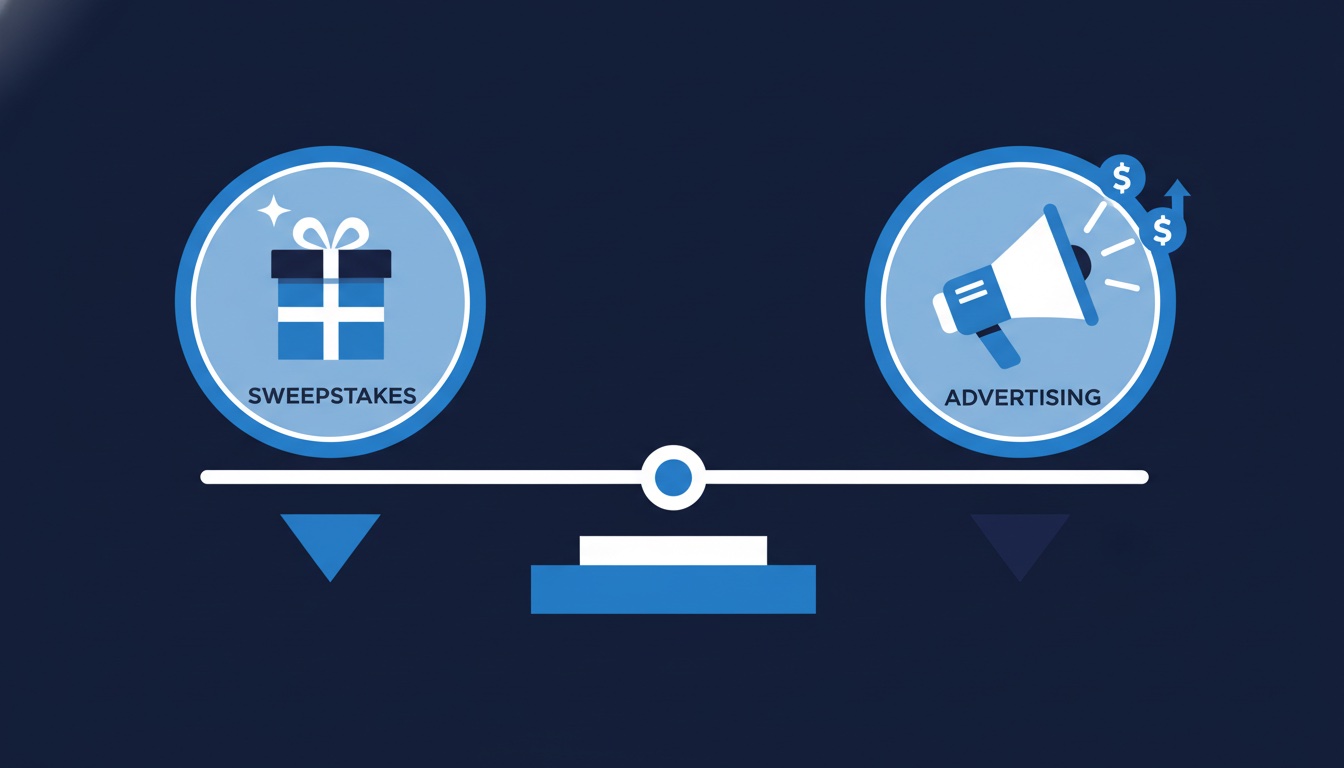
Every marketing budget faces the same question: where does the next dollar go? Paid advertising is the default answer for most brands — Google Ads, Facebook Ads, LinkedIn Ads — because the infrastructure is familiar and the results are immediate. But the data increasingly shows that sweepstakes and contests deliver leads at a fraction of paid ad costs.
This isn't an argument that sweepstakes should replace paid ads. It's a data-driven look at how the two channels compare on cost, audience quality, data ownership, and scalability — so you can make informed allocation decisions instead of defaulting to whatever you did last quarter.
The Cost Per Lead Comparison
The most straightforward comparison between sweepstakes and paid ads is cost per lead (CPL). This is where the case for sweepstakes is most compelling.
| Channel | Average CPL (2025) | Range by Industry | Lead Type |
|---|---|---|---|
| Google Ads (Search) | $70.11 | $28-$132 | High-intent searchers |
| Facebook/Meta Ads | $27.66 | $3-$80 | Interest/behavior targeted |
| LinkedIn Ads | $75-$100+ | $50-$150+ | Professional/B2B targeted |
| Sweepstakes/Contests | $0.50-$3.00 | $0.05-$5.00 | Prize-motivated entrants |
| Content marketing | $15-$50 | $10-$100+ | Information seekers |
The gap is dramatic. Google Ads averages $70.11 per lead across all industries. Facebook Ads averages $27.66. Sweepstakes consistently deliver leads at $0.50-$3.00 — often 10-50x cheaper than paid search and 5-20x cheaper than paid social.
But CPL alone doesn't tell the full story. A $0.50 lead that never opens an email is worth less than a $70 lead that becomes a $5,000 customer. The sections below dig into the quality, intent, and downstream value differences between these channels.
Audience Quality: Intent vs. Volume
The fundamental difference between sweepstakes leads and paid ad leads is intent. Someone who searches "best CRM software" on Google has explicit purchase intent. Someone who enters a sweepstakes for a free product bundle has prize intent, not necessarily purchase intent.
| Dimension | Paid Ads (Search) | Paid Ads (Social) | Sweepstakes |
|---|---|---|---|
| Primary motivation | Solving a problem | Triggered by content | Winning a prize |
| Purchase intent | High | Medium | Low-Medium |
| Volume per dollar | Low | Medium | High |
| Data richness | Keyword + click only | Interest signals | Form fields + behaviors |
| Retargetability | Cookie/pixel dependent | Platform dependent | Email (owned channel) |
| Lifetime value potential | High (intent-driven) | Medium | Medium (nurture-dependent) |
This isn't a weakness of sweepstakes — it's a difference in funnel position. Paid search captures demand. Sweepstakes create demand. They serve different strategic purposes and should be evaluated on different timelines. A sweepstakes lead needs nurturing before it converts; a paid search lead is often ready to buy now.
The prize selection heavily influences lead quality. A brand-relevant prize (your own products, experiences tied to your brand) attracts people interested in what you sell. A generic cash prize attracts everyone — including sweepstakes hobbyists with no purchase intent.
Prize relevance is your quality filter
If you're getting high entry volume but low email engagement, your prize is too generic. Switch from cash or electronics to your own products or services. You'll get fewer entries, but the entrants will look much more like your actual customers. A $500 gift card to your store is a better lead filter than a $500 Visa card.
The First-Party Data Advantage
In the post-cookie world, the data ownership question is becoming as important as the cost question. This is where sweepstakes have a structural advantage over paid advertising.
| Data Aspect | Paid Ads | Sweepstakes |
|---|---|---|
| Data ownership | Platform owns the data | You own the data |
| Contact information | No direct access | Email, name, phone, address — whatever you collect |
| Platform dependency | Lose access if you stop paying | Data persists in your CRM forever |
| Consent basis | Implicit (cookie/pixel) | Explicit (form submission with consent) |
| Privacy compliance | Depends on platform policies | You control collection and consent |
| Retargeting capability | Platform-dependent, cookie-limited | Direct email, multi-channel |
With third-party cookies now deprecated across all major browsers, paid ad targeting and measurement are becoming less precise and more expensive. Safari and Firefox already blocked third-party cookies, affecting roughly 30% of web traffic. Chrome's deprecation extends that to over 90% of global browser usage.
Sweepstakes collect first-party data with explicit consent. Participants voluntarily fill out forms, check consent boxes, and provide the information you need for personalized marketing — all in a compliant, privacy-forward way. This data doesn't expire, doesn't depend on a platform's targeting algorithm, and can't be taken away by a browser update.
For a deeper dive into promotional data strategy, see our first-party data collection guide.
 Revup
Revup
Revup captures first-party data through 40 form field types with built-in email and SMS consent checkboxes — and syncs directly with your email platform through 10 native integrations including Klaviyo, HubSpot, Mailchimp, and ActiveCampaign.
Scalability Comparison
Paid ads have one clear advantage: immediate, linear scalability. If you want 2x the leads, you spend 2x the budget (approximately — CPL typically rises with volume). The results are predictable and available on demand.
Sweepstakes scale differently. They have higher fixed costs (prize, setup, legal) but near-zero marginal costs (each additional entry doesn't cost you anything). This means sweepstakes are more cost-efficient at scale — but reaching that scale requires effective promotion.
| Factor | Paid Ads | Sweepstakes |
|---|---|---|
| Time to results | Immediate | Ramp-up over campaign duration |
| Cost structure | Linear (pay per click/lead) | Fixed costs + near-zero marginal |
| Scaling method | Increase budget | Increase promotion + referral mechanics |
| Diminishing returns | CPL rises with volume | CPL decreases with volume (fixed costs spread) |
| Predictability | High (historical data) | Medium (depends on prize + promotion) |
| Minimum viable spend | $500-$1,000/month | $500-$2,000 per campaign (including prize) |
The practical implication: paid ads are better for consistent, always-on lead flow. Sweepstakes are better for concentrated campaigns that generate large volumes at low cost. Most effective marketing plans use both.
Email List Building: Head-to-Head
When the goal is specifically email list growth, sweepstakes outperform paid ads on nearly every metric. Email marketing continues to deliver the highest ROI of any channel — $36-$45 for every $1 spent — which makes the cost of acquiring each subscriber critically important.
| Metric | Paid Ads → Email Capture | Sweepstakes → Email Capture |
|---|---|---|
| Landing page conversion | 5-15% | 25-40% |
| Cost per email subscriber | $5-$25 | $0.50-$3.00 |
| Consent quality | Varies by funnel | Explicit opt-in at entry |
| 30-day open rate | 20-30% | 25-35% (prize-relevant audience) |
| Subscriber lifetime value | Improves once the subscriber is on an owned list | Same — channel matters less than nurture quality once you have consent |
| List growth per campaign | Steady drip | Large burst (hundreds to thousands) |
The landing page conversion difference is the key driver. Sweepstakes landing pages convert at 25-40% because the value proposition is clear and immediate — enter your email, get a chance to win something valuable. Paid ad landing pages for email capture (newsletter signups, lead magnet downloads) convert at 5-15% because the value proposition is less compelling.
For a complete email list building strategy using promotions, see our sweepstakes email list building guide.
When to Use Sweepstakes Over Paid Ads
Sweepstakes are the better choice when:
Use Sweepstakes When...
- Your primary goal is email list growth — sweepstakes deliver 5-20x lower cost per email
- You need first-party data with explicit consent — critical in the post-cookie landscape
- Your paid ad CPL has risen to unsustainable levels — sweepstakes offer a cost reset
- You want to grow social followings alongside email — sweepstakes do both simultaneously
- You're launching a new product and need awareness — promotions generate buzz and sharing
- You have an existing audience to seed the campaign — owned channels make promotion cheaper
- You want to collect preference data — quiz and survey sweepstakes capture rich zero-party data
When to Use Paid Ads Over Sweepstakes
Paid ads are the better choice when:
Use Paid Ads When...
- You need leads immediately — paid ads deliver within hours, sweepstakes take days to ramp
- You need high-intent leads ready to buy now — paid search captures active demand
- You want predictable, steady lead flow — paid ads run continuously, sweepstakes are campaigns
- You're in a high-LTV B2B market — $70/lead is acceptable if average contract is $50,000+
- You need precise geographic or demographic targeting — paid platforms offer granular controls
- You're testing messaging or offers — paid ads allow rapid A/B testing at small scale
- Your industry has regulatory constraints on sweepstakes — some verticals restrict promotions
The Combined Strategy: Using Both
The most effective marketing plans don't choose one or the other — they use paid ads to promote sweepstakes, creating a flywheel that combines the targeting precision of paid media with the cost efficiency of promotional marketing.
The Paid + Sweepstakes Flywheel
Launch sweepstakes with organic promotion
Announce to your email list and social followers first. This seeds initial entries and establishes a baseline conversion rate before you spend on ads.
Use paid ads to drive traffic to your sweepstakes
Run Facebook and Instagram ads targeted to lookalike audiences of your existing customers. The sweepstakes landing page will convert at 25-40% — far higher than a standard landing page — so your paid ad CPL drops dramatically.
Capture first-party data from every entrant
Every paid ad click that converts into a sweepstakes entry gives you an email address and whatever additional data you collect. You now own this contact regardless of future ad platform changes.
Build lookalike audiences from sweepstakes data
Upload your sweepstakes entrant list to Facebook/Google to create refined lookalike audiences. These audiences are based on people who actually engaged with your brand, not just interest signals.
Nurture sweepstakes leads via email
Move entrants into your email marketing funnel. Email delivers $36-$45 per dollar spent — so even if only a fraction of sweepstakes entrants convert, the downstream value is substantial.
Revup
Revup integrates with all major email platforms and supports UTM tracking for paid campaigns — so you can run the paid + sweepstakes flywheel with full attribution visibility from ad click to email subscriber to customer.
Budget Allocation Framework
If you're currently spending 100% of your acquisition budget on paid ads, here's a practical framework for adding sweepstakes to the mix:
| Stage | Paid Ads | Sweepstakes | Rationale |
|---|---|---|---|
| Test (Month 1) | 90% | 10% | Run first sweepstakes, establish baselines |
| Validate (Months 2-3) | 80% | 20% | Compare CPL and lead quality across channels |
| Optimize (Months 4-6) | 70% | 30% | Scale sweepstakes based on ROI data |
| Mature (Months 7+) | 50-60% | 40-50% | Balanced allocation based on performance |
Start conservative. Run your first sweepstakes as a test alongside your existing paid program. Compare CPL, lead quality (30-day email engagement), and downstream conversion. Let the data guide your allocation — don't make sweeping budget shifts based on one campaign.
Track both channels with the same metrics
For a fair comparison, measure both paid ads and sweepstakes using the same KPIs: cost per lead, 30-day email engagement rate, 90-day conversion to customer, and customer lifetime value. Use UTM parameters on all links so your analytics platform can attribute downstream conversions to the correct source.
The Rising Cost Problem
One trend makes the sweepstakes case stronger every year: paid ad costs are rising steadily. Facebook ad costs jumped 21% in 2025 alone, with the average CPL increasing from $22.85 to $27.66. Google Ads costs have followed a similar trajectory across most industries.
These increases are driven by competition (more advertisers competing for the same inventory), privacy changes (less precise targeting = higher costs to reach the right audience), and platform monetization pressure. There's no indication that this trend will reverse.
Sweepstakes costs, by contrast, are relatively stable. The major cost components — prizes, platform fees, and legal — don't inflate with advertiser demand. This makes promotional marketing an increasingly attractive complement to paid advertising as CPLs continue to rise.
Frequently Asked Questions
Should I stop running paid ads and switch to sweepstakes?
No. Paid ads and sweepstakes serve different strategic purposes. Paid ads capture existing demand from people actively searching for your solution. Sweepstakes create new demand by reaching people who aren't actively searching but match your target profile. The best results come from using both channels together — paid ads for immediate, high-intent leads and sweepstakes for cost-efficient list building and awareness.
How do I compare the quality of a sweepstakes lead to a paid ad lead?
Measure both using the same downstream metrics: 30-day email engagement (open rate, click rate), 90-day conversion to customer, and customer lifetime value. Tag your leads by source so you can compare cohorts. Sweepstakes leads typically show lower immediate conversion rates but can reach comparable lifetime value with proper nurturing.
What if my sweepstakes attracts mostly prize-seekers who never buy?
This usually means your prize is too generic. Cash prizes and iPads attract sweepstakes hobbyists. Your own products, brand experiences, or industry-specific prizes attract potential customers. Also check your traffic sources — entries from sweepstakes directories will convert at much lower rates than entries from your own audience channels. Segment your analysis by source to get an accurate picture of lead quality.
Can I use paid ads to promote my sweepstakes?
Absolutely — this is one of the most effective strategies. Sweepstakes landing pages convert at 25-40%, far above the 5-15% typical of standard landing pages. This means your paid ad spend goes further when it drives traffic to a sweepstakes versus a standard lead form. The result is lower effective CPL than either channel achieves alone.
What about retargeting — do sweepstakes help?
Yes. Every sweepstakes entry captures an email address, which is the most durable retargeting asset available. Unlike pixel-based retargeting (which is degraded by cookie deprecation and ad blockers), email retargeting works across all platforms and doesn't depend on browser cookies. You can also upload sweepstakes entrant lists to ad platforms to create custom audiences for retargeting campaigns.
Ready to add sweepstakes to your acquisition mix? Start with our sweepstakes marketing strategy guide for the complete framework, or check the ROI benchmarks to set your performance targets.